
10 Most Amazing Birds in the World | Retorno Photo Tours
The 10 Most Amazing Birds of the World
Somewhere between a hummingbird's wingbeat and an eagle's silence, there's a whole category of birds that seem almost too extraordinary to be real. Some dazzle with color. Others astonish with scale, rarity, or the sheer improbability of their design. All of them reward the photographer willing to travel far, wait long, and watch closely.
Here are ten of the most amazing birds on Earth — where to find them, what makes each one so remarkable, and how attainable they really are through a lens.
1. Andean Cock-of-the-Rock
Where to find it: The cloud forests of the Andes, from Venezuela and Colombia south through Ecuador, Peru, and Bolivia.
Characteristics: Few birds announce themselves quite like the male Andean Cock-of-the-Rock — a brilliant orange-red bird with a striking disc-shaped crest that all but erases his beak from view. At dawn, males gather at traditional lek sites to perform competitive displays for visiting females, filling the forest with an almost theatrical energy.
Ease of photographing: Genuinely accessible. Established leks in Colombia's central Andes, as well as in Ecuador and Peru, are monitored by local guides who know exactly when and where males will display, making this one of the more reliable — and rewarding — species on this list.
2. Resplendent Quetzal
Where to find it: The highland cloud forests of Central America, from southern Mexico to Panama, with Costa Rica, Guatemala, and Panama offering the most consistent sightings.
Characteristics: The male Resplendent Quetzal grows elongated tail streamers that can trail up to a meter behind him, set against iridescent emerald-green plumage and a vivid crimson breast. Revered by the Maya and Aztecs as a symbol of freedom and divinity, it remains one of the most culturally significant birds in the Americas.
Ease of photographing: Moderate. Sightings are seasonal — breeding season, roughly March through June, is by far the best window — and require access to the cloud forest with a guide who tracks fruiting trees and known nesting cavities.
3. Rainbow-bearded Thornbill
Where to find it: High-elevation Andes of central and southern Colombia, Ecuador, and northern Peru, typically between 2,700 and 3,600 meters.
Characteristics: This small hummingbird carries an outsized name for good reason — males display an elongated, multicolored throat gorget that shifts between copper, green, and violet depending on the light.
Ease of photographing: Moderate. The altitude and constant motion make this a technically demanding subject, but feeders at select highland lodges — including sites in Colombia's coffee region — offer some of the most reliable access anywhere in its range.
4. Green-bearded Helmetcrest
Where to find it: Endemic to Colombia's Eastern Andes, in the páramo grasslands of Cundinamarca and Boyacá, at elevations up to 5,200 meters.
Characteristics: A true páramo specialist, this hummingbird sports a spiked white crest and a glittering green "beard," feeding almost exclusively on the towering flowers of Espeletia — the iconic frailejón plants of the high Andes.
Ease of photographing: Challenging. Its extremely narrow range and high-altitude habitat mean this bird requires a dedicated páramo excursion — but for photographers chasing true Colombian endemics, few subjects are more rewarding.
5. Purple-backed Thornbill
Where to find it: The Andes from Venezuela through Colombia, Ecuador, Peru, and into Bolivia.
Characteristics: With the shortest bill of any hummingbird species, the Purple-backed Thornbill compensates with unmistakable style — males wear a brilliant metallic purple back and a forked, purplish-black tail, often performing arcing courtship dances in front of females.
Ease of photographing: Moderate. It favors elfin forest edges near the treeline and can be elusive alone, but frequently joins other hummingbirds at flowering trees, creating good opportunities when timed well.
6. Harpy Eagle
Where to find it: From southern Mexico to northern Argentina, with the healthiest populations concentrated in the Amazon Basin — including Colombia, Peru, and Brazil.
Characteristics: The Harpy Eagle is one of the most powerful raptors on the planet, with talons larger than a grizzly bear's claws and the strength to lift prey like sloths and monkeys straight out of the canopy. Its presence signals genuinely intact, mature rainforest.
Ease of photographing: Difficult. This is not a species you stumble upon — it demands active nest monitoring, remote access, and significant patience. But for photographers who put in the time, few images carry more weight than one of a Harpy Eagle in its natural habitat.
7. Striolated Manakin
Where to find it: Lowland and foothill forests across western and northern South America — Colombia, Ecuador, Peru, Venezuela, Guyana, and Brazil.
Characteristics: The male's bright red crown and bold white-streaked belly make this small manakin unmistakable once spotted. Males perform in "exploded leks," calling from favored perches and occasionally breaking into rapid, buzzing wing displays to attract females.
Ease of photographing: Moderate. The bird itself is inconspicuous, but its display, while infrequent, is predictable once a lek site is known — a case where local knowledge makes all the difference.
8. Multicolored Tanager
Where to find it: Endemic to Colombia alone, in the western and central Andes — including Valle del Cauca, Chocó, Risaralda, and Antioquia.
Characteristics: This is a bird that seems to have been designed by committee — golden face, emerald nape, cerulean underparts, and a black-and-chestnut ear patch, all on a bird barely 12 centimeters long. It's one of the most visually complex tanagers found anywhere.
Ease of photographing: Relatively accessible. Found year-round in Colombia's private reserves, it regularly visits fruit feeders, offering excellent, close-range photographic opportunities for a bird found nowhere else on Earth.
9. Versicolored Barbet
Where to find it: The eastern Andean slopes of Peru and Bolivia, generally between 750 and 2,100 meters.
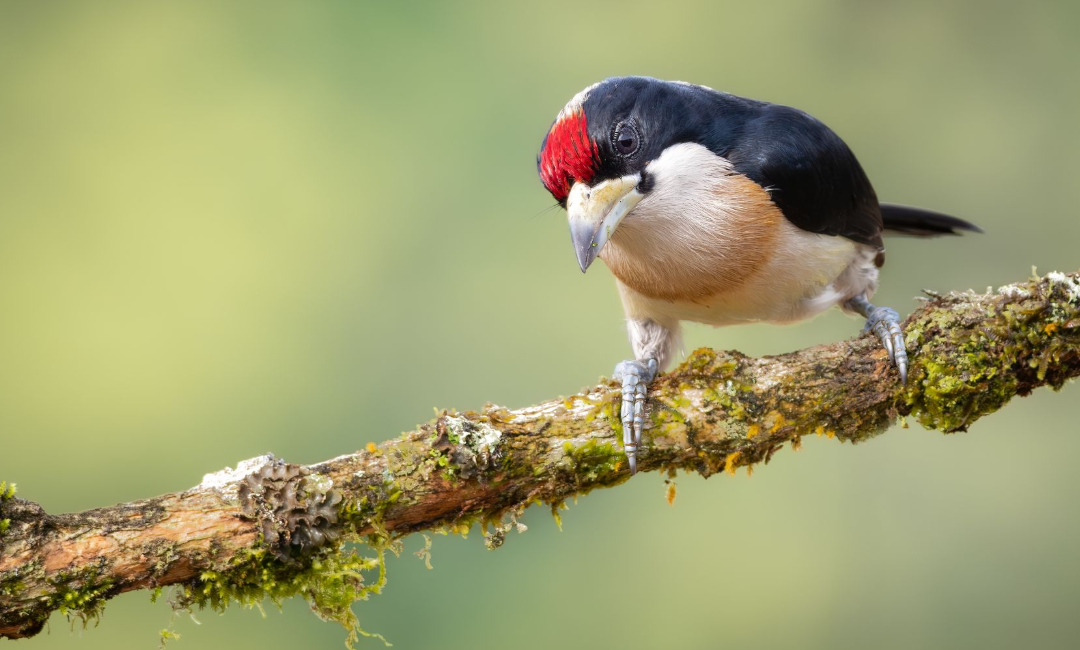
Characteristics: True to its name, the Versicolored Barbet wears a striking mix of colors that varies by subspecies — a red face and crown paired with either a blue or yellow "mustache," depending on where in its range you find it.
Ease of photographing: Difficult. It's uncommon to rare across its limited range and tends to stay high in the canopy, making sightings — let alone clean photographs — a genuine reward for persistence.
10. Keel-billed Toucan
Where to find it: From southern Mexico through Central America into northern Colombia and Venezuela.
Characteristics: The Keel-billed Toucan's oversized, rainbow-colored bill is one of the most recognizable features in the entire bird world — bright green, orange, red, and blue in a single, improbably lightweight structure.
Ease of photographing: Comparatively easy. It's often found near fruiting trees and, in many reserves and lodges across its range, has grown accustomed enough to human presence to allow excellent, unhurried photography.
A World Worth Traveling For
From the páramo heights of Colombia to the misty highlands of Panama, these ten birds represent some of the most extraordinary photographic subjects on the planet — each one a study in patience, timing, and respect for the wild places they call home.
At Retorno Photo Tours, several of these species — including the Andean Cock-of-the-Rock, the Multicolored Tanager, the Green-bearded Helmetcrest, and the Harpy Eagle — are part of the encounters we build our Colombia expeditions around, alongside our growing Resplendent Quetzal program in Panama.
Ready to photograph birds like these? Get in touch with Retorno Photo Tours at dcasas@retornobirding.com to start planning your next expedition.