
12 Top Andean Birds to Photograph in Colombia
The Top Andean Birds to Photograph in Colombia
A flash of turquoise vanishes into cloud forest. A helmetcrest hovers inches from a flowering shrub in the páramo. Far above a wax-palm valley, a parrot flock cuts across the morning sky. These are the moments that make the top Andean birds to photograph in Colombia far more than a checklist. They are demanding, often brief encounters in landscapes where altitude, weather, and local knowledge shape every frame.
Colombia’s three Andean cordilleras hold an extraordinary concentration of endemics, range-restricted specialties, and brilliantly colored mountain birds. For photographers, the appeal is not simply the species count. It is the chance to work in intimate forest, open highland terrain, private reserves, and community-managed lands where a patient approach can produce portfolio-level images.
1. Multicolored Tanager
The Multicolored Tanager is one of Colombia’s great photographic rewards: a compact bird painted in electric blue, green, yellow, and chestnut. It favors humid Andean forest, especially on the western slopes, where it often joins active mixed flocks. The challenge is its constant movement through layered vegetation. Look for it early, work a clean opening in the canopy, and prioritize fast shutter speeds over extremely low ISO settings.
2. Gold-ringed Tanager
Endemic to Colombia’s Western Andes, the Gold-ringed Tanager deserves unhurried time. Its black plumage, golden edging, and deep blue tones can look spectacular against mossy branches or fruiting trees, but dark forest light makes exposure difficult. Protect the bright yellow feather edges, then lift shadows carefully in post-processing. Well-managed feeding stations can create excellent opportunities, though natural perches and a restrained setup usually make the stronger image.
3. Black-and-gold Tanager
The Black-and-gold Tanager is another high-value Colombian endemic, with a graphic pattern that rewards close portrait work. It occurs in humid montane forest and can be surprisingly cooperative at elevations where cold rain and mist are part of the day’s rhythm. A rain cover, dry cloth, and accessible spare battery matter as much as your long lens. A 400mm or 500mm lens provides ideal working distance when the bird remains in natural cover.
4. Green-bearded Helmetcrest
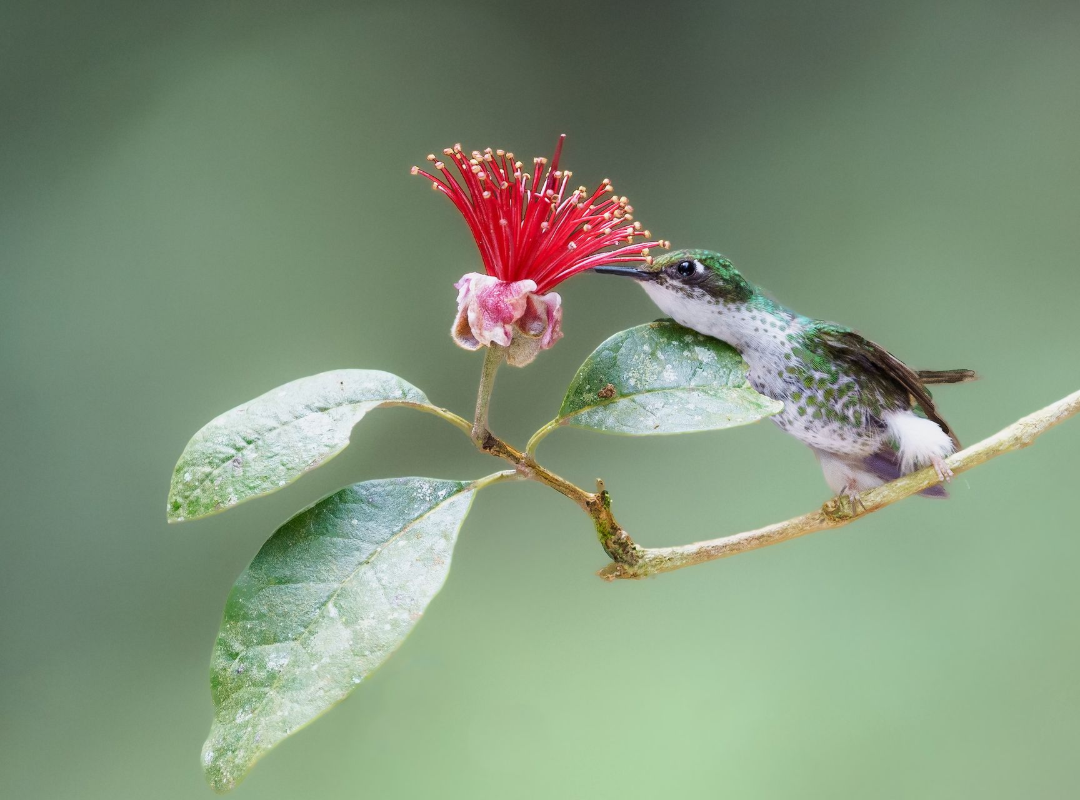
Few subjects feel more distinctly Andean than the Green-bearded Helmetcrest. This tiny hummingbird is a páramo specialist, found among frailejones and flowering high-altitude shrubs in the Central Andes. Its iridescence changes dramatically with angle and light, so a technically sharp frame is only the start. Spend time observing favored feeding routes, use a fast shutter speed, and wait for a natural hover against a soft, uncluttered background.
High-altitude photography brings trade-offs. Clear dawns can be wonderfully productive, yet temperatures may be near freezing, while cloud and rain can arrive quickly later in the morning. Layered clothing and weather protection for camera bodies are essential.
5. Sword-billed Hummingbird
The Sword-billed Hummingbird is unmistakable. Its bill is longer than its body, an adaptation for reaching the deep flowers of Andean forests. It can be photographed at flowering shrubs and carefully managed hummingbird stations, but the best frames reveal the extraordinary bill in context: perched beside a tubular bloom or hovering at a natural flower. Avoid crowding the bird or monopolizing a feeding location. Short, thoughtful sessions are better for both the image and the subject.
6. Andean Cock-of-the-rock
The male Andean Cock-of-the-rock seems almost unreal in the dim green of the cloud forest. Its blazing orange-red body, crescent-shaped crest, and active lek displays make it a favorite for photographers who enjoy behavior as much as color. Low light is the central technical problem. A stabilized telephoto lens, a solid shooting position, and realistic ISO expectations will serve you better than chasing a perfectly clean file at an unusably slow shutter speed.
7. Yellow-eared Parrot
The Yellow-eared Parrot carries a story of recovery and conservation as powerful as its photographic appeal. This endangered species is closely associated with high Andean forest and wax palm landscapes, where it often travels in noisy flocks. Flight images demand preparation: identify the direction birds use to enter or leave a roosting area, set exposure for the sky before the flock arrives, and keep enough shutter speed for wing detail. Its welfare must come first, especially near nesting and roost sites.
8. Fuertes’s Parrot
Fuertes’s Parrot is one of the most sought-after endemics in the Colombian Andes and among the most difficult birds to photograph responsibly. Its restricted range, conservation sensitivity, and canopy-level habits mean encounters should never be forced. The strongest approach is to work with experienced local guides who understand current access rules, community agreements, and seasonal movements. A distant but authentic canopy image can be more meaningful than a close frame obtained with disturbance.
9. Cauca Guan
The Cauca Guan is a handsome Colombian endemic with chestnut tones, a pale throat, and a red dewlap that catches the light beautifully. It is often easier to hear than see, moving quietly through mature forest and edges. Because it can be wary, photographers should use a patient, stationary approach rather than advancing each time the bird shifts position. Forest trails with known fruiting trees can offer the best chance for eye-level compositions.
10. White-mantled Barbet
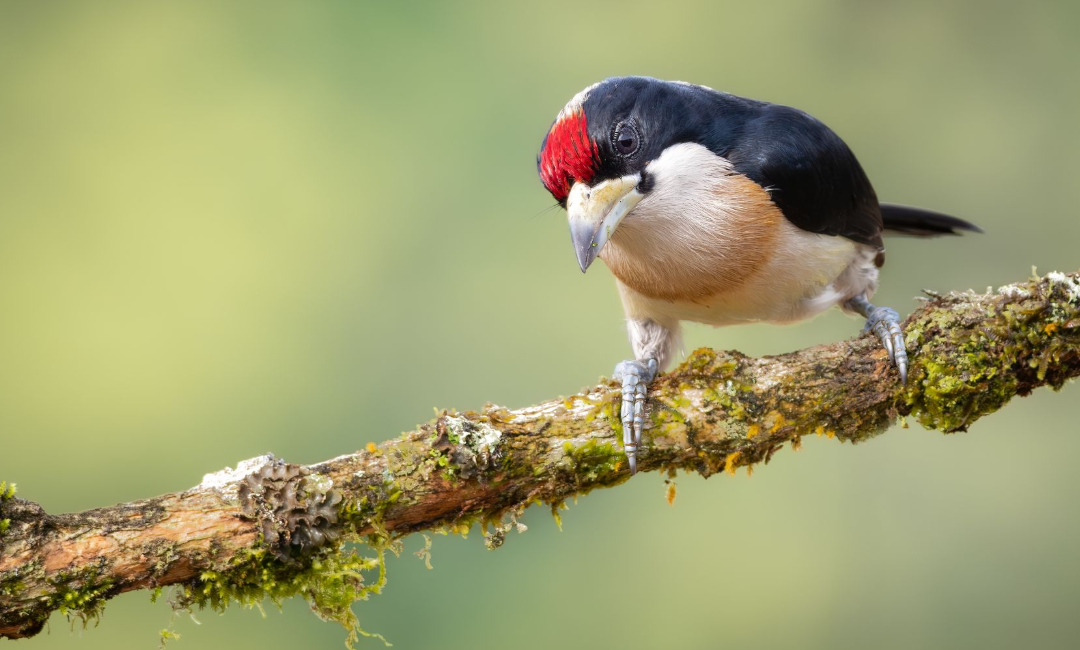
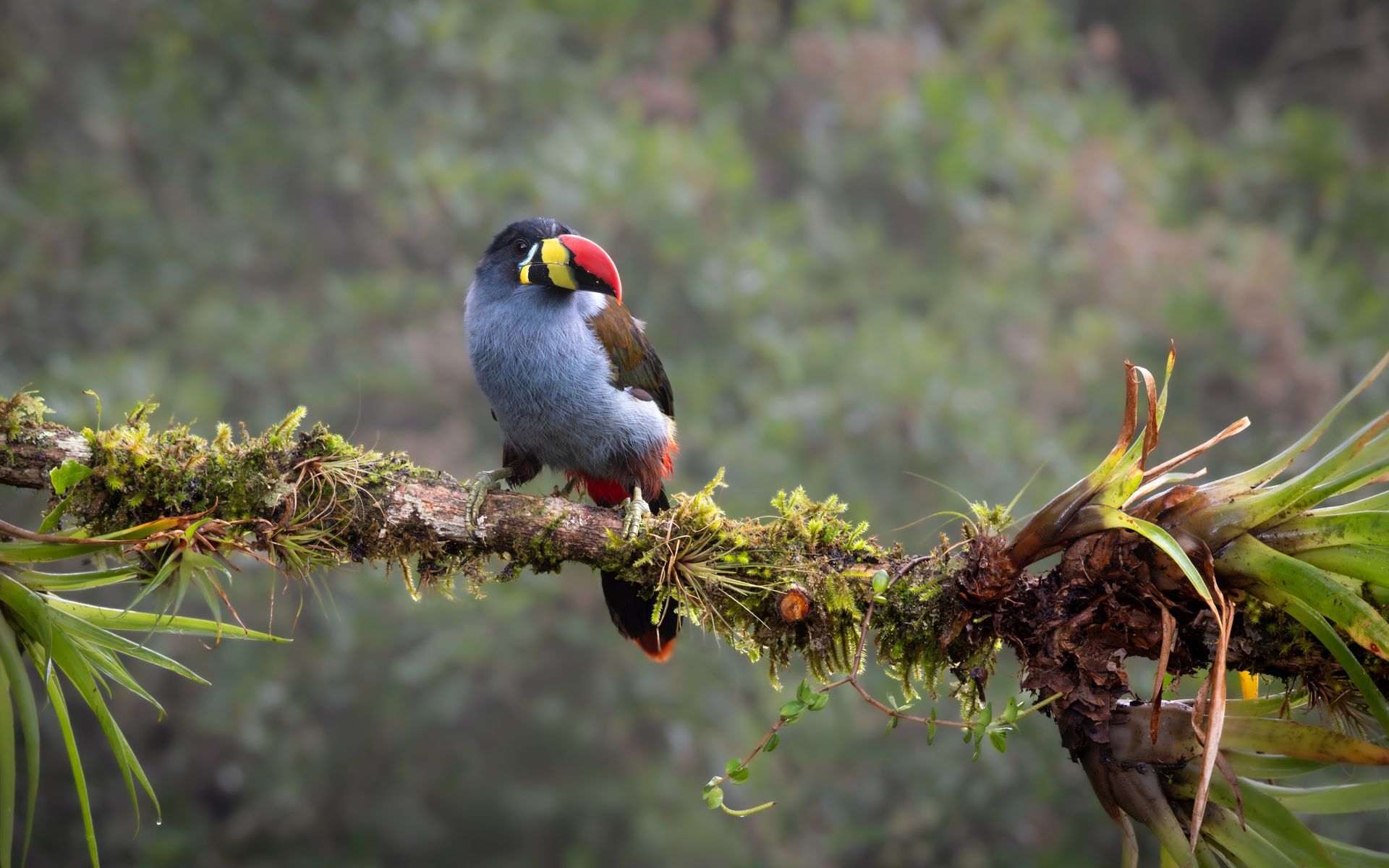
The White-mantled Barbet is an Andean specialty whose vivid red head and clean white mantle stand out in fruiting trees. It is generally a more approachable subject than many canopy birds, but it still requires careful background control. Photograph from a position that places the bird against distant vegetation rather than a busy tangle of branches. Watch for feeding behavior as well. A berry held at the bill can turn a strong portrait into a story-rich image.
11. Crescent-faced Antpitta
Antpittas represent a different kind of Andean photography: understated color, intense presence, and the patience of the forest floor. The Crescent-faced Antpitta is especially rewarding where accessible trails and ethical local guiding make observation possible. Keep your camera low without blocking the trail, choose a single clean angle, and let the bird set the pace. Calling birds repeatedly or stepping off established paths can disrupt the very habitat that supports them.
12. Andean Condor
The Andean Condor offers a complete change of scale. Rather than working from a shaded forest trail, you may be photographing a massive soaring bird against cliffs, valleys, or dramatic mountain weather. A 100-400mm or similar zoom can be more useful than a fixed super-telephoto lens because condors can appear suddenly and pass close overhead. Frame wider than instinct suggests. The landscape is part of the species’ visual power.
Planning a Productive Andean Bird Photography Expedition
The best itinerary depends on your priorities. A photographer focused on endemics may spend multiple days in one elevation band, waiting for weather and bird activity to align. Someone building a broad Colombia portfolio may combine páramo hummingbirds, cloud-forest tanagers, and lower-elevation forest species across several regions. Trying to cover every habitat too quickly usually means more driving and fewer meaningful photographic opportunities.
Conditions vary by mountain range and elevation. Colombia’s equatorial location means there is no single nationwide bird-photography season, although regional rainfall patterns affect road access, flowering cycles, and forest light. Early mornings are reliably valuable, while afternoons often favor rain protection, image review, and travel between lodges. A local team can adjust the day around current fruiting trees, active leks, and weather rather than following a rigid plan.
Bring a camera body that performs confidently at higher ISO settings, a long lens in the 400mm-plus range, and a second option for hummingbirds or flight photography. A teleconverter can be useful for distant parrots and canopy species, but only if light and autofocus performance allow it. For many forest birds, a sharp image at 500mm with a clean background is more valuable than extra reach compromised by motion blur.
Photograph With Respect for the Mountains
Andean bird photography depends on intact habitat and on the people who live beside it. The best field practices are simple: remain on designated trails, keep voices low, avoid playback except where research-based local protocols permit it, and never pressure a bird for a closer frame. At feeding stations, choose operators that maintain clean conditions, limit crowding, and support conservation rather than treating wildlife as a prop.
At Retorno Photo Tours, we believe the finest photographs come from time, access, patience, and respect. When your journey supports rural communities and habitat protection, each image carries more than color and rarity. It carries the place that made the encounter possible.
Give the Andes enough time. The bird you remember most may not be the rarest name on your list, but the one that appears after a long wait, in perfect mountain light, on its own terms.