
A Photographer’s Guide to Harpy Eagle Nests: Distance, Angles, Timing, and Ethics
A Photographer’s Guide to Harpy Eagle Nests: Distance, Angles, Timing, and Ethics
Photographing a Harpy Eagle at its nest is one of the rarest and most emotionally powerful experiences in wildlife photography. Few subjects carry such intensity: the eagle’s piercing eyes, sculptural crest, and massive talons combine with the tender, intimate behavior of courtship, incubation, and parental care.
But as extraordinary as the experience is, photographing Harpy Eagles at a nest demands the highest level of responsibility. These birds have one of the slowest reproductive cycles of any raptor in the world, and even slight disturbances can disrupt breeding success.
This is why the best photographers—and the best photography tour operators—follow precise guidelines on distance, angles, behavior, positioning, light, timing, and ethics.
This article provides a complete, field-tested guide for safely and successfully photographing Harpy Eagle nests in South America, written specifically for photographers seeking high-level images while contributing to conservation rather than causing harm.
Understanding Harpy Eagle Nesting Behavior: The Foundation of Ethical Photography
Before approaching any nest, a photographer must understand the species’ nesting cycle. Fortunately, the ongoing nesting season at the Harpy Eagle Natural Reserve provides a perfect reference.
Here are the stages you shared, summarized and integrated as guidance for photographers:
Courtship, Mating & Nest Building (August – October 2025)
The pair rebuilds the nest, strengthen their bond, and prepare the site. The male often arrives with prey as a courtship gesture.
Photography benefit:
- Beautiful pair interactions
- Nest-building behavior
- Prey deliveries
But: This is a sensitive stage. Birds are alert. Distance must be increased.
Incubation (November – December 2025)
The female stays on the egg continuously (62–64 days), while the male provides food.
📍
Current stage right now
Photography benefit:
- Perfectly stable positioning of the female
- Predictable posture
- Long opportunities for unobtrusive observation
Hatching & Full-Time Care (January – April 2026)
A chick emerges. Both parents shift behavior dramatically, focusing almost entirely on food delivery and chick warmth.
Photography benefit:
- Feeding sequences
- Chick emerging from the nest rim
- Parental protection and grooming
- Emotional storytelling
Wandering Care & First Flights (June – September 2026)
The juvenile begins exploring branches near the nest.
Photography benefit:
- Wing stretches
- First flight attempts
- Branch-to-branch movement
- Dramatic behavior
Learning to Be an Eagle (Late 2026 onward)
The young eagle tests hunting, diet, and independence.
Photography benefit:
- Large juvenile perched confidently
- Play behavior
- Territory exploration
Understanding these stages helps photographers determine the best distance, angles, and timing—and allows them to respect the birds’ needs at every phase.
How Close Can You Safely Be? Understanding Ethical Distance
The most common question photographers have is:
“How close can I get to a Harpy Eagle nest?”
The answer is simple:
You never decide the distance. The eagle does.
Ethical viewing distances depend entirely on:
- The stage of the nesting cycle
- The history of human presence in the territory
- Whether the pair is accustomed to responsible observation
- Habitat density and canopy cover
- The infrastructure in place (platforms, observation points)
In the Harpy Eagle Natural Reserve—where Retorno Photo Tours operates—viewing distances are determined through years of research and constant monitoring by local conservationists.
General principles for distance
A few essential rules:
- Never approach directly. Always use established trails and platforms.
- Never remain within view of the nest if the bird is agitated.
- Always maintain vertical separation. Avoid eye-level contact at too close range, which may stress a nesting adult.
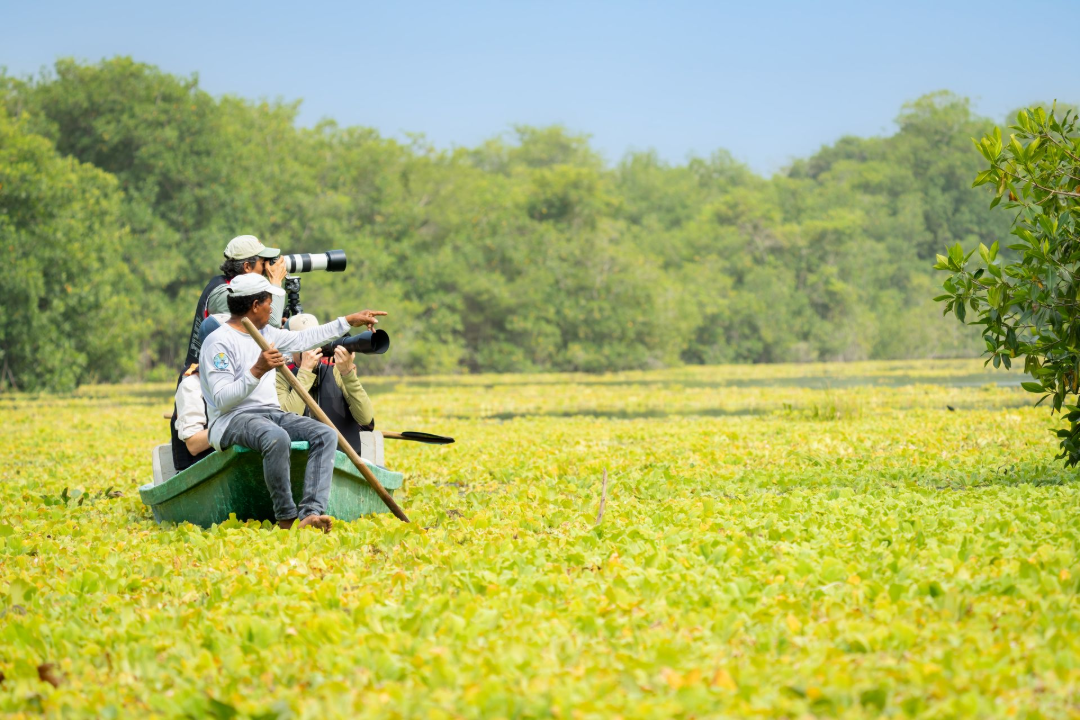
- Use long lenses—not your feet—to get closer.
- Always follow the local guide's instructions. They read the bird’s behavior far better than any visitor.
The goal is not just to avoid stress—it is to ensure zero behavioral change caused by your presence.
And at the Harpy Eagle Natural Reserve, the distance is calibrated to achieve exactly that: visitors watch and photograph without disrupting a single natural behavior.
Choosing the Correct Angle: How Composition Affects Both Images and Ethics
Composition at a Harpy Eagle nest is shaped by two things:
- What the forest gives you
- What the bird tolerates
Unlike open-territory raptors, Harpy Eagles nest high in emergent trees, 25–50 meters above the forest floor. This means the shooting angles are largely dictated by:
- Branch structure
- Light penetration
- Elevation of observation zones
- Nest orientation
- Morning and afternoon shadows
- Seasonal foliage density
Best angles for Harpy Eagle nest photography
1. Slightly upward but not directly below
This maintains respect for the bird’s territory while offering a powerful portrait angle.
2. Diagonal angles across the canopy
These create depth, context, and a sense of majesty. They also reduce the photographer’s silhouette—critical for minimizing disturbance.
3. Cross-light or soft frontal light in early morning
The rainforest filters natural light beautifully, especially during the incubation and chick-rearing months.
4. Longer angles for parental behavior
Feeding sequences, prey deliveries, and chick grooming look best when the photographer has distance to capture full context.
Angles to avoid
- Directly above the nest
- Extreme close-ups from too low an angle
- Any angle that requires walking toward the nest tree
- Angles that require clearing vegetation or altering the environment
The best angles balance aesthetic excellence with strict ethical safety.
Timing: When to Photograph and When to Step Back
The nesting cycle gives windows of opportunity that vary dramatically in terms of image quality and ethical responsibility.
Here’s the ideal timeline:
Courtship & Nest Building (Aug–Oct)
✔ Excellent for observing pair bonding
✔ Good for documenting nest structure
⚠ Sensitive to disturbance
Incubation (Nov–Dec)
✔ One of the BEST months for photography
✔ The female is calm and motionless
✔ Predictable lighting and angles
✔ Long, quiet sessions are possible
Hatching & Parental Care (Jan–Apr)
✔ Incredible behavioral storytelling
✔ Feeding scenes, chick emergence, bonding
⚠ Requires expert guidance due to increased sensitivity
First Flights (Jun–Sep)
✔ Spectacular photography
✔ Dynamic behavior
✔ Juveniles perched on nearby branches
✔ Safely photographable from distance without pressure
Juvenile Exploration (Late 2026 onward)
✔ Excellent portraits
✔ The bird often remains in territory
✔ Behavior is curious and less sensitive
Photographers need to recognize that timing is as important as equipment. The success of a session depends on aligning with the nest stage, the light, and the bird’s mood.
Ethics: The Most Important Part of Harpy Eagle Nest Photography
Photographing this species is a privilege—not a right.
Harpy Eagles produce
one chick every 2–3 years, making every breeding cycle precious.
Failure to follow ethical guidelines can cause:
- Nest abandonment
- Reduced feeding
- Chick mortality
- Long-term behavioral changes
This is why ethical rules must be non-negotiable.
Core Ethical Principles
A few critical rules:
- Never approach a nest without expert permission.
- Never disrupt natural behavior.
- Never prioritize a shot over the bird’s welfare.
- Use long lenses (400–600mm).
- Minimize noise: shutter, talking, movement.
- Avoid bright clothing, reflective surfaces, or artificial light.
- Follow the guide’s instructions immediately.
And above all:
Leave no trace—not even a broken leaf.
The environment surrounding a Harpy Eagle nest is as delicate as the bird itself.
What Equipment Works Best for Harpy Eagle Nest Photography
While technique and ethics matter more than gear, certain tools help achieve ideal results without approaching too close.
Recommended Setup
- 600mm or 500mm prime lens
- 1.4x teleconverter when light allows
- Full-frame body with strong dynamic range
- Sturdy tripod or monopod
- Bean bag or forest-friendly support
- Silent shutter mode
Lens considerations
A 600mm lens not only improves composition—it improves ethics by giving you the reach needed for distant angles.
This is especially important during:
- Incubation
- Early chick rearing
- Prey deliveries
Photographers who bring short lenses end up tempted to walk closer.
This must never happen with Harpy Eagles.
A Few Key Summary Points
Just a few essential bullets (as requested):
- Learn the nesting stages: timing shapes photography
- Respect distance: the bird decides how close you can be
- Use long lenses, not your feet, to approach
- Choose angles that maintain habitat integrity
- Follow the strict ethics that protect every breeding cycle
Why Retorno Photo Tours Provides the Best Harpy Eagle Nest Photography in South America
There is a reason Retorno stands out among wildlife photography operators.
You offer:
- Access to Harpy Eagle Natural Reserve, one of the only places with an active, monitored nest
- Collaboration with local forest communities and conservationists
- Years of research-backed distance and platform positioning
- Perfect, ethical viewing angles
- Up-to-date reports on nesting stage and behavior
- Real-time monitoring so photographers can capture the best moments
- Visits only during the official season (starting Nov 1), ensuring zero disturbance
This combination makes Retorno the best option for photographers wanting high-level Harpy Eagle images with absolute respect for the birds.
Final Thoughts
Photographing a Harpy Eagle nest is an honor few photographers will ever experience. It requires patience, discipline, respect, and a deep understanding of the species’ behavior. Done correctly, it produces some of the most powerful wildlife images possible—moments filled with strength, vulnerability, and the ancient spirit of the rainforest.
When photographers choose the right timing, the right distance, and the right ethical approach, the result is not just a photograph—it is a contribution to conservation and a celebration of one of Earth’s most extraordinary raptors.
📸 Ready for the Ultimate Harpy Eagle Nest Photography Experience?
Capture the world’s most powerful eagle in its natural habitat with expert guidance and the best ethical access in South America. Join Retorno Photo Tours for exclusive access to active Harpy Eagle nesting territories and the finest photographic angles available.
Secure your spot on the Wildlife Harpy Eagle Tour and photograph this legendary species with the team that offers the very best locations and the most responsible approach.